
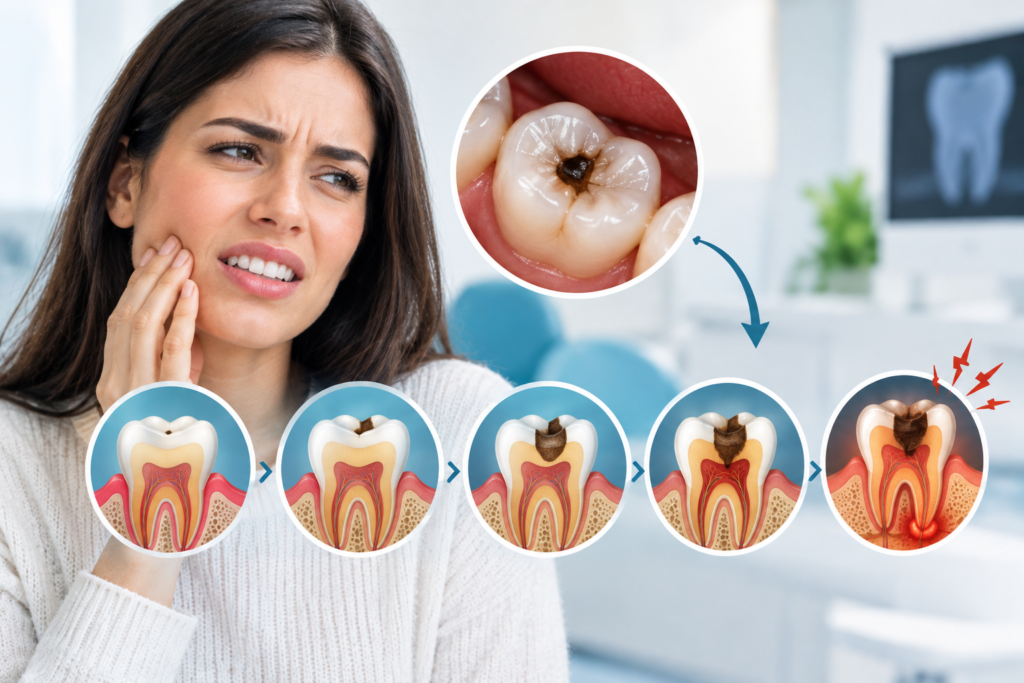
It started with a small black spot. David noticed it while brushing one morning. It did not hurt. It did not bother him while eating. Life was busy, so he told himself he would get it checked later.
Weeks passed. Then months. One day, while drinking a cold soda, he felt a sharp pain shoot through his tooth. That tiny spot he had ignored was no longer a small problem. This happens more often than people think.
Many patients visit dentists Miami residents trust after waiting too long to treat a cavity. By that point, what could have been a simple filling sometimes turns into a much bigger procedure.
So, what really happens when a cavity is ignored.
A Cavity Does Not Heal on Its Own
One of the biggest misconceptions about cavities is that they will eventually go away. Unfortunately, that is not how cavities work. A cavity forms when bacteria and acids damage the outer layer of the tooth.
Once that damage creates a hole in the tooth, it cannot repair itself. The cavity will continue to grow unless it is treated.
That is why early dental care is so important.
The Cavity Gets Deeper
At first, a cavity affects only the outer surface of the tooth. Many people feel no pain during this stage.
That is often why they delay treatment. But while there may be no symptoms, the decay continues moving deeper into the tooth. Eventually, it reaches the softer inner layer called dentin.
At this point, you may start noticing:
- Sensitivity to cold drinks
- Sensitivity to sweets
- Mild discomfort while eating
- Occasional tooth pain
Many dentists Miami patients visit see this situation every day.
The cavity started small but became larger because treatment was postponed.
Tooth Pain Becomes More Frequent
As decay gets closer to the nerve, pain often becomes more noticeable. What was once a little sensitivity may turn into sharp pain, throbbing discomfort, pain while chewing or toothaches that come and go.
Some people notice the pain becomes worse at night when they are trying to sleep.
This is usually a sign that the problem has progressed beyond the early stages.
The Nerve Can Become Infected
If decay reaches the center of the tooth, it may affect the nerve. This is where things become more serious. An infected tooth may cause constant pain, swelling, sensitivity to pressure, a bad taste in the mouth or gum tenderness around the tooth. At this stage, a simple filling may no longer be enough.
More advanced treatment may be needed to save the tooth.
You Could Lose the Tooth
Many people do not realize that untreated cavities can eventually lead to tooth loss. When a tooth becomes severely damaged, there may not be enough healthy structure left to support it.
The result could be an extraction.
Losing a tooth can affect:
- Chewing ability
- Speech
- Appearance
- Overall oral health
This is why dentists encourage patients to treat cavities early rather than waiting.
Treatment Usually Becomes More Expensive
Another reason people postpone dental visits is cost. Ironically, waiting often leads to more expensive treatment. A small cavity may only require a simple filling. A larger cavity may require a crown, root canal treatment or tooth replacement options.
The longer decay remains untreated, the more complicated the solution may become.
Last Words
A cavity may seem small today, but it rarely stays that way. What begins as a tiny area of decay can slowly grow into pain, infection, and even tooth loss. The good news is that early treatment is usually simple and effective.
The team at dentists Miami practices often reminds patients that treating a cavity early is one of the easiest ways to protect a healthy smile. A quick visit today can help prevent much bigger problems tomorrow.
FAQs
Can a cavity go away without treatment?
No. Once a cavity forms, it will not heal on its own.
How do I know if I have a cavity?
Common signs include sensitivity, pain, visible holes, or dark spots on a tooth.
Does every cavity hurt?
No. Many cavities cause no pain during the early stages.
What happens if a cavity reaches the nerve?
The tooth may become infected and require more advanced treatment.
Is it cheaper to treat a cavity early?
Yes. Early treatment is usually simpler and less expensive than treating advanced decay.