
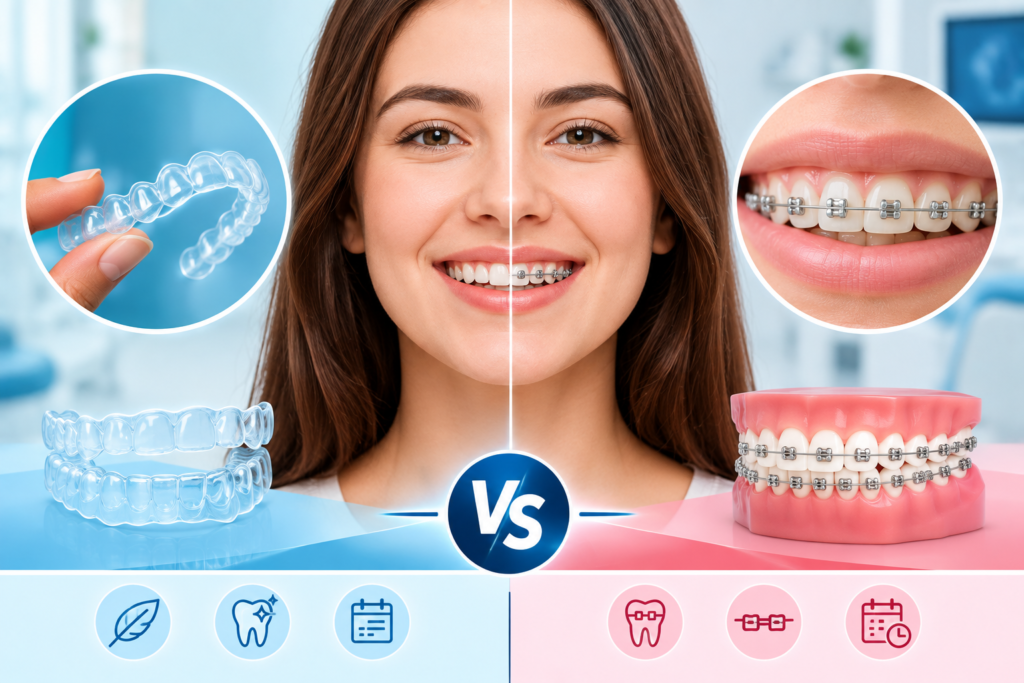
If you are thinking about straightening your teeth, the big question is often whether to choose Invisalign or traditional braces. Both treatments help create a better smile, fix bite issues and support healthier teeth overall. They just go about it in their own ways and each comes with real advantages.
The right pick depends on your dental situation, how you live day to day and what matters most to you. Talking to a trusted dentist in Miami is the smartest first step; they can look at your teeth and give honest advice that fits your needs.
Let’s break down the differences between Invisalign and braces in a straightforward way.
What Is Invisalign?
Invisalign works with a set of clear, removable aligners that slowly move your teeth into their proper positions. Each aligner is made just for you using digital scans of your mouth. You wear one set for about one to two weeks, then switch to the next.
Because they’re almost invisible, Invisalign has become really popular with adults and teens who don’t want their treatment to stand out.
What Are Traditional Braces?
Traditional braces use brackets—either metal or ceramic—that are glued to your teeth and connected with wires. Your dentist adjusts the wires every few weeks to keep guiding your teeth into better alignment.
Braces have been helping people for many years and still do an excellent job, especially when dealing with both simple and more challenging orthodontic problems.
Invisalign vs. Braces: Key Differences
Appearance
One of the most noticeable differences is how they look. Invisalign aligners are clear and blend in with your teeth, so most people won’t even realize you’re wearing them. Braces are visible when you smile, although today’s versions are smaller and less bulky than they used to be.
If staying discreet is important to you, Invisalign usually wins in this area.
Comfort
You’ll need some time to adjust with either option. Invisalign aligners feel smooth and are less likely to irritate your cheeks or gums. Braces can cause soreness after adjustments, and the brackets sometimes rub against the inside of your mouth. Over time, both become much more comfortable.
Eating and Drinking
Invisalign makes life easier here. You take the aligners out before eating or drinking anything except water, so you can enjoy your regular meals without restrictions. With braces, you have to watch out for sticky, hard, or crunchy foods that might break the wires or brackets.
Oral Hygiene
Cleaning your teeth is simpler with Invisalign since you can remove the aligners and brush and floss normally. Braces stay on your teeth, so you’ll need to spend extra time cleaning around the brackets and wires every day.
Treatment Time
How long treatment takes depends on your individual case. Many people finish Invisalign in 12 to 18 months. Braces often take 18 to 24 months. Tougher cases can take longer no matter which method you choose. Your dentist will give you a realistic timeline after checking your teeth.
Which Treatment Is Better for Complex Cases?
Both Invisalign and braces can fix crowded teeth, gaps, overbites, underbites and crossbites. However, braces are often the better choice for very severe problems because they give more precise control. Invisalign has improved a lot and now handles many cases that once needed braces. Your dentist will help figure out what’s best for you.
Lifestyle Considerations
Invisalign needs commitment—you have to wear the aligners 20 to 22 hours a day. Taking them out too often can slow things down. Braces are always there working, so they’re easier if you worry about remembering to wear something removable. This can be especially helpful for younger patients.
How Do You Choose?
There’s no one perfect answer for everyone. Think about your age, budget, daily routine and how serious your dental issues are. The best way to decide is by visiting an experienced dentist in Miami. They’ll examine your smile, and recommend what will work best for you.
Conclusion
Invisalign and traditional braces are both solid choices that can truly transform your smile, and improve your oral health. Invisalign offers a nearly invisible, removable option that fits busy lifestyles, while braces remain a dependable solution for more complex cases.
If you’re thinking about orthodontic treatment, reach out to a trusted dentist in Miami. A personal consultation will help you choose the path that feels right for your smile and your life.
Frequently Asked Questions
Is Invisalign faster than braces?
Often yes for milder cases—many finish in 12 to 18 months—but it depends on your specific needs.
Which is more comfortable, Invisalign or braces?
Most patients say Invisalign feels more comfortable thanks to the smooth aligners.
Can Invisalign fix severe alignment problems?
It can treat many issues now but very complex cases may still need braces.
Can I eat normally with Invisalign?
Yes, just remove the aligners for meals and brush before putting them back in.